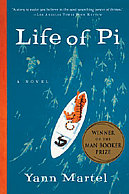
Against all odds, I managed to start AND finish Life of Pi this weekend. My house is on the market and my mind is pre-occupied with things like SELL FOR THE LOVE OF GOD THE CLOCK IS TICKING, but I found myself at the gym with no desire to have sweaty headphones upsetting the balance of ear cleanliness I've become accustomed to, on top of the irrational pressure I've placed on myself to participate in this (very patient and lenient) book club I've joined... and suddenly Life of Pi was my treadmill distraction.
I'll admit that I've never been a member of any book club, let alone an online one. I've held back for so long that I've seen enough other members admit to the same thing to put me at ease about this sad fact. Notice I'm still mentioning it, though... take this all with a grain of salt, I guess is my point. Also, I'm trying to say that I'm not exactly positive how to start a discussion on a book with as many layers as I detected in Life of Pi.
***WARNING: Possible Spoiler Ahead***
Luckily for me, there is a nifty Reading Group Guide in the version of the book I bought. It has a series of thought-provoking questions, all of which are equally as profound, I'm sure. I'm going to pick one that works for focusing on what to me is the crux of the book: #22,
Which story do you believe, the one with animals or the one without animals? I'm not sure I can directly answer this question, but I will say this: I read the first two parts of the book without questioning any of the "facts." When I got to the third part and Pi was pressured to tell a different story, I was pretty unhappy. I clung to the animal story with all my might. I wanted it to be true, as harrowing as I'd thought it was originally. I might have actually felt
angry at the investigators from the Japanese Ministry of Transport for pressuring Pi to come up with something different. Like Pi, I had become attached to Richard Parker, that wild, dangerous, dependent, unpredictable killer companion. When the animal characters were replaced with human ones, when Pi explained in human terms what he'd endured for months at sea, it felt remarkably more unbearable, and to my chagrin, remarkably more
believable.
Throughout the re-telling of Pi's experience, he makes reference to imagination, belief, and the role of the story in one's life. He accepts what most people would classify as three conflicting religious belief systems when he simultaneously practices Hinduism, Christianity, and Islam. When confronted on this and told he must choose only one faith, his response is "I just want to love God." Pi simultaneously accepts the frameworks he's given, no matter how contradictory, no matter how unpalatable, and molds them to what he views as a universal expression of gratitude for life. He accepts atheism as a belief system, but rejects agnostic doubt as a potential life-long philosophy, claiming that doubt is not a habitable realm, but one that must be visited temporarily and later abandoned for more solid ground, "the better story."
Life is ultimately only relatable by the story-telling of our own experience. Pi's two stories begin and end identically; the differences between the tellings come down to character details, but those details profoundly alter the reader's view of the experience. The Japanese investigators ultimately have to choose which story
they'll tell, and even after their significant and vocal doubt surrounding Pi's first telling, ultimately the one they pass on in official record is "the one with animals," which they deem in irony, emotional self-defense, or spiritual respect, the better story. This surprised me, until I realized, as I tried to describe the book to my husband, that I was telling Pi's first story as
the story, the "real" one.